
Origin and inspiration:
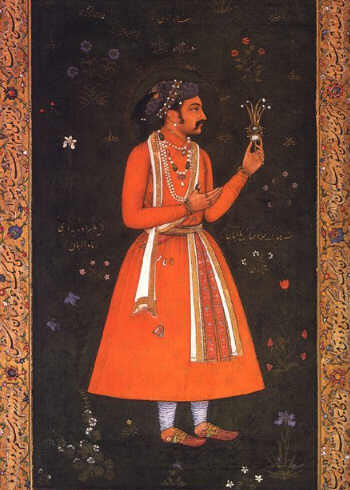
In 1631, Shah Jahan, emperor during Mughal's period of greatest prosperity, was griefstricken when his third wife, Mumtaz Mahal, died during the birth of their fourteenth child, Gauhara Begum. The court chronicles of Shah Jahan's grief illustrates the love story traditionally held as an inspiration for Taj Mahal. The construction of Taj Mahal begun soon after Mumtaz's death with the principal mausoleum completed in 1648. The surrounding buildings and garden were finished five years later. Visiting Agra in 1663, French traveller François Bernier wrote:
I shall finish this letter with a description of the two wonderful mausoleums which constitute the chief superiority of Agra over Delhi. One was erected by Jehan-guyre [sic] in honour of his father Ekbar; and Chah-Jehan raised the other to the memory of his wife Tage Mehale, that extraordinary and celebrated beauty, of whom her husband was so enamoured it is said that he was constant to her during life, and at her death was so affected as nearly to follow her to the grave.
I shall finish this letter with a description of the two wonderful mausoleums which constitute the chief superiority of Agra over Delhi. One was erected by Jehan-guyre [sic] in honour of his father Ekbar; and Chah-Jehan raised the other to the memory of his wife Tage Mehale, that extraordinary and celebrated beauty, of whom her husband was so enamoured it is said that he was constant to her during life, and at her death was so affected as nearly to follow her to the grave.
Agra, once the capital of the Mughal Empire during the 16th and early 18th centuries, is one and a half hours by express train from New Delhi. Tourists from all over the world visit Agra not to see the ruins of the red sandstone fortress built by the Mughal emperors but to make a pilgrimage to Taj Mahal, India’s most famous architectural wonder, in a land where magnificent temples and edificies abound to remind visitors about the rich civilization of a country that is slowly but surely lifting itself into an industrialized society.
The postcard picture of Taj Mahal does not adequately convey the legend, the poetry and the romance that shroud what Rabindranath Tagore calls "a teardrop on the cheek of time". Taj Mahal means "Crown Palace" and is in fact the most well preserved and architecturally beautiful tomb in the world. It is best described by the English poet, Sir Edwin Arnold, as "Not a piece of architecture, as other buildings are, but the proud passions of an emperor’s love wrought in living stones." It is a celebration of woman built in marble and that’s the way to appreciate it.
When Mumtaz Mahal was still alive, she extracted four promises from the emperor: first, that he build the Taj; second, that he should marry again; third, that he be kind to their children; and fourth, that he visit the tomb on her death anniversary. He kept the first and second promises. Construction began in 1631 and was completed in 22 years. Twenty thousand people were deployed to work on it. The material was brought in from all over India and central Asia and it took a fleet of 1000 elephants to transport it to the site. It was designed by the Iranian architect Ustad Isa and it is best appreciated when the architecture and its adornments are linked to the passion that inspired it. It is a "symbol of eternal love".
The Taj rises on a high red sandstone base topped by a huge white marble terrace on which rests the famous dome flanked by four tapering minarets. Within the dome lies the jewel-inlaid cenotaph of the queen. So exquisite is the workmanship that the Taj has been described as "having been designed by giants and finished by jewellers". The only asymmetrical object in the Taj is the casket of the emperor which was built beside the queen’s as an afterthought. The emperor was deposed by his son and imprisoned in the Great Red Fort for eight years but was buried in the Taj. During his imprisonment, he had a view of the Taj.
As a tribute to a beautiful woman and as a monument for enduring love, the Taj reveals its subtleties when one visits it without being in a hurry. The rectangular base of Taj is in itself symbolic of the different sides from which to view a beautiful woman. The main gate is like a veil to a woman’s face which should be lifted delicately, gently and without haste on the wedding night. In indian tradition the veil is lifted gently to reveal the beauty of the bride. As one stands inside the main gate of Taj, his eyes are directed to an arch which frames the Taj.
The dome is made of white marble, but the tomb is set against the plain across the river and it is this background that works its magic of colours that, through their reflection, change the view of the Taj. The colours change at different hours of the day and during different seasons. Like a jewel, the Taj sparkles in moonlight when the semi-precious stones inlaid into the white marble on the main mausoleum catch the glow of the moon. The Taj is pinkish in the morning, milky white in the evening and golden when the moon shines. These changes, they say, depict the different moods of woman.
Different people have different views of the Taj but it would be enough to say that the Taj has a life of its own that leaps out of marble, provided you understand that it is a monument of love. As an architectural masterpiece, nothing could be added or substracted from it.
Many architects have rated it as the most perfect of all buildings standing on earth. Three artists designed it: a Persian, an Italian, and a Frenchman. But the design is completely Mohammedan. Even the skilled artisans who built it were brought in from Baghdad, Constantinople, and other centers of the Muslim faith. For 22 years more than 20,000 workmen were forced to build the Taj. The Maharaja of Jaipur sent the marble as a gift to Shah Jahan. The building and its surroundings cost more than $200,000,000 in todays currency.
Passing through a high wall, one comes suddently upon the Taj - raised upon a marble platform, and framed on either side by handsome mosques and stately minarets. In the foreground spacious gardens enclose a pool in whose waters the inverted palace becomes a quivering dream. Every portion of the structure is of white marble, precious metals, or costly stones. The building is a complex figure of twelve sides, four of which are portals. A slender minaret rises at each corner, and the roof is a massive spired dome. The main entrance, once guarded with solid silver gates, is a maze of marble embroidery; inlaid in the wall in jeweled script are qotations from the Koran, one of which invites the "pure in heart" to enter "the gardens of Paradise."
Shah Jahan had begun his reign by killing his brothers; but he had neglected to kill his sons, one of whom was destined to overthrow him. In 1657 his son Aurangzeb led an insurrection from the Deccan. Aurangzeb defeated all the forces sent against him, captured his father, and imprisoned him in the Fort of Agra. For 9 bitter years the deposed emperor lingered there, never visited by his son, attended only by his faithful daughter Jahanara, and spending his days looking from the Jasmine Tower of his prison across the Jumna to where his once-beloved Mumtaz lay in her jeweled tomb.
Passing through a high wall, one comes suddently upon the Taj - raised upon a marble platform, and framed on either side by handsome mosques and stately minarets. In the foreground spacious gardens enclose a pool in whose waters the inverted palace becomes a quivering dream. Every portion of the structure is of white marble, precious metals, or costly stones. The building is a complex figure of twelve sides, four of which are portals. A slender minaret rises at each corner, and the roof is a massive spired dome. The main entrance, once guarded with solid silver gates, is a maze of marble embroidery; inlaid in the wall in jeweled script are qotations from the Koran, one of which invites the "pure in heart" to enter "the gardens of Paradise."
Shah Jahan had begun his reign by killing his brothers; but he had neglected to kill his sons, one of whom was destined to overthrow him. In 1657 his son Aurangzeb led an insurrection from the Deccan. Aurangzeb defeated all the forces sent against him, captured his father, and imprisoned him in the Fort of Agra. For 9 bitter years the deposed emperor lingered there, never visited by his son, attended only by his faithful daughter Jahanara, and spending his days looking from the Jasmine Tower of his prison across the Jumna to where his once-beloved Mumtaz lay in her jeweled tomb.
The new emperor Aurangzeb was a more pious Muslim than his father Shah Jahan had been. He memorized the entire Koran, spent days in fasts, and campaigned against infidelity. He cared little for luxuries, but, paradoxically, gave the world one of its most perfect works of art: a marble screen inside the Taj Mahal. Native and European thieves robbed the tomb of its abundant jewels, and of the gold railing, encrusted with precious stones, that once enclosed the sarcophagi of Shah Jahan and his Queen. Aurangzeb replaced the railing with an octagonal screen of almost transparent marble, carved into a miracle of alabaster lace. Few products of human art have ever surpassed the beauty of this screen.
From afar the Taj Mahal, with its delicate details, is not imposing. Only a nearer view reveals that its perfection has no proportion to its size. When in our hurried times, we see enormous structures of a hundred stories raised in a year, and then consider how 20,000 men worked for 22 years on this little tomb, hardly a hundred feet high, we begin to sense the difference between industry and art. And perhaps more importantly, we sense the ultimate lesson it offers: beauty and that which lasts, is based on love.




No comments:
Post a Comment